
Google launched dedicated Search Generative AI performance reports in Search Console on June 3, 2026. The new reports give site owners a standalone view of how their content appears within generative AI features on Search, including AI Overviews and AI Mode, and within generative AI features on Discover. This data was previously folded into the overall Performance report with no way to isolate it.
What metrics are included in the generative AI performance reports?
The reports cover impressions, pages, countries, devices, and dates, including hourly, daily, weekly, and monthly granularity. Click data is not included; Google has said it will add additional metrics over time. For now, impressions are the only measure of how often your URLs appear inside AI-generated search features
Who has access to the generative AI Search Console reports right now?
Both the new reports and the AI blocking toggle are starting with a subset of UK website owners before a broader global rollout. If the reports are not yet visible in your account, your site may not be in the initial test cohort. No firm date has been given for when the feature will reach all properties globally.
What is the AI blocking toggle that launched alongside the reports?
Google also introduced an opt-out toggle that lets site owners remove their content from AI Overviews and AI Mode without affecting organic rankings. Google confirmed the opt-out setting will not be used as a ranking signal for regular Search. The control takes effect in Google Search on June 17, 2026, and is currently available to configure for a subset of UK site owners during a testing period.
How is the new AI blocking toggle different from Google-Extended or nosnippet?
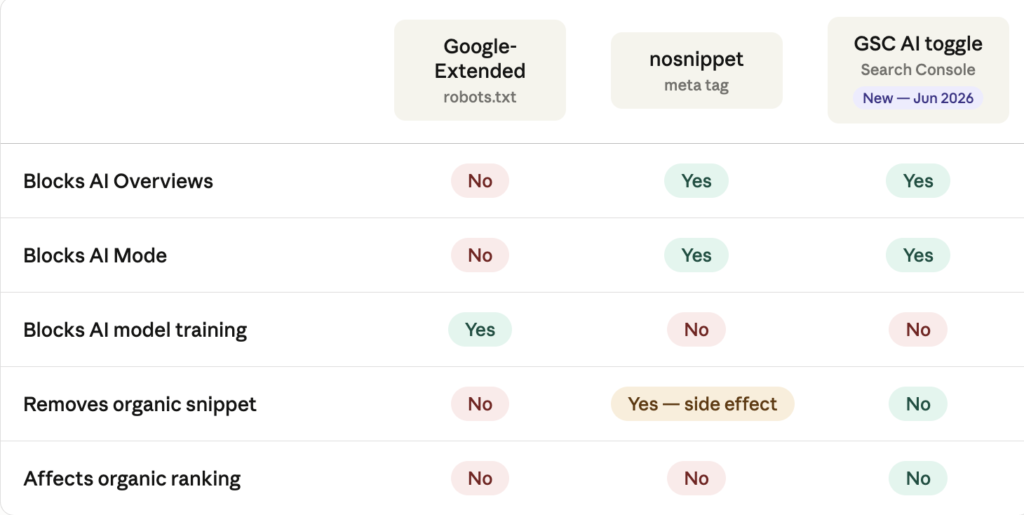
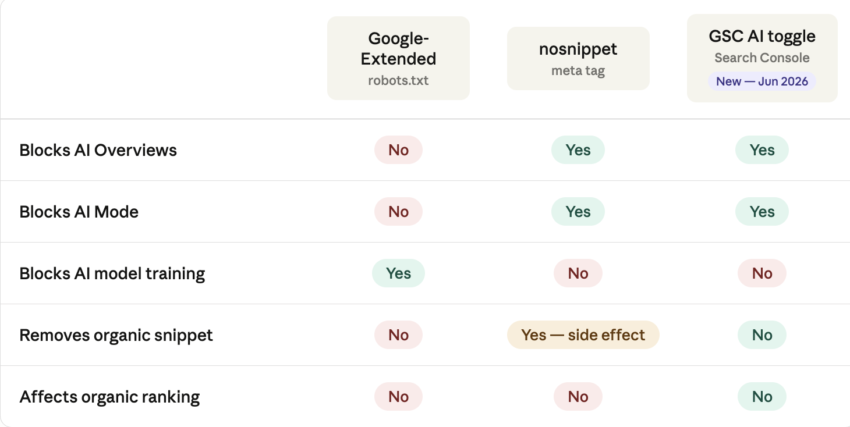
Google-Extended blocks AI model training but not AI Overviews. The nosnippet directive blocks AI features but also strips your organic snippet. The new Search Console toggle is the first control that blocks AI features with no organic-snippet tradeoff. Each control does a distinct job, they are not interchangeable, and conflating them leads to unintended consequences for your organic visibility.
My take: what this means for practitioners right now
I've been tracking the gap between AI search visibility and measurable data for a while now, and this announcement feels like the moment the infrastructure finally starts catching up to the reality of how Google Search actually works in 2026.
Let me be direct about what this is: it's a first step, not a solved problem. Until now, data from generative AI features was bundled into the overall Performance report. That meant every SEO trying to understand their AI Overviews or AI Mode exposure was either guessing or triangulating from CTR anomalies. That era is over, at least in principle.
The missing click data is the big caveat here. Impressions tell you that your content is appearing inside AI-generated results. They don't tell you whether anyone is clicking through as a result. And that's precisely the tension that defines the current moment in search: visibility in AI features doesn't automatically mean traffic. In fact, for many queries, it might mean the opposite, users get their answer from the AI summary and never visit your site.
What this data set will let us do is benchmark. You can now see which pages are being pulled into AI Overviews and AI Mode, broken down by country, device, and date. That's a foundation for real GEO strategy, not just publishing and hoping. If a page has high AI impressions but low organic clicks, that's a signal worth acting on: either the page needs a stronger call to action for users who do click through, or the content strategy needs rethinking for a world where the AI is the endpoint.
The opt-out toggle deserves its own strategic consideration. Most sites shouldn't flip it. But publishers with subscription models, paywalled content, or content that depends heavily on first-click attribution should review that decision carefully before June 17.
What to do this week
Go into Search Console and check whether the new reports are live for your property. If they are, export the top pages by AI impressions and cross-reference them with your standard organic performance. The delta will tell you a lot.